


Why Your Calorie Deficit not Working? (and How to Fix It)
You’ve cut calories, logged meals, maybe even added cardio—yet the scale won’t budge. Frustrating, right? This guide explains why your calorie deficit not working and gives clear, science-backed steps to get fat loss moving again. Whether you’re seeing water retention, adaptive metabolism, or tracking errors, you’ll leave with a checklist that actually works.
Quick Reality Check: What Counts as a Plateau?
Before you overhaul anything, confirm it’s truly a stall:
- No net loss in 3–4 weeks when using weekly averages, not single weigh-ins
- Measurements (waist/hips), progress photos, and clothes fit unchanged
- Activity, sleep, and adherence have been consistent
If that describes you, move on to the fixes below.
12 Reasons Your Calorie Deficit Isn’t Showing Up on the Scale
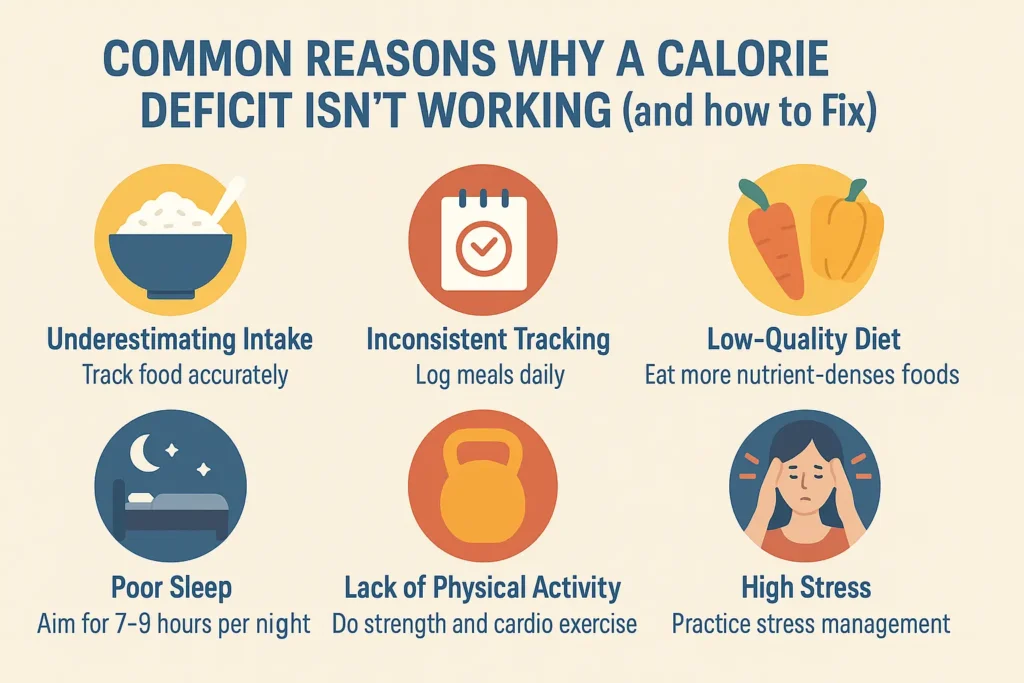
1) You’re Eating More Than You Think
- Untracked “bites/licks/tastes,” cooking oils, dressings, sugary drinks
- Scale your food (grams) and log accurately for 7–10 days
- Watch calorie-dense “healthy” foods (nuts, nut butters, avocado)
2) Output Is Lower Than You Think
Fitness trackers overestimate calorie burn. Consider not “eating back” all exercise calories—or cap it at ~50–70%.
3) Water Retention Is Masking Fat Loss
Sodium spikes, menstrual cycle, hard training, stress, creatine, and poor sleep can hold 1–3+ kg water. Track weekly averages, not daily noise.
4) NEAT Drops as You Diet
Your subconscious movement (Non-Exercise Activity Thermogenesis) falls when you cut calories. Counter by targeting 7–10k steps/day and taking movement breaks.
5) Macros Are Off (Protein Too Low)
Aim 1.6–2.2 g/kg body weight for protein. Protein preserves muscle, raises satiety, and improves diet adherence.
6) Fiber & Food Volume Too Low
Low-fiber diets are harder to sustain. Shoot for 25–35g fiber/day via veggies, fruit, legumes, oats, chia, whole grains.
7) Weekends Undo Weekdays
A “perfect” Mon–Fri can be erased by 2 high-calorie days. Keep weekend structure: same breakfast, pre-log meals, or set a calorie “floor + cap.”
8) Sleep Debt & Stress
<7 hours sleep, chronically high stress, or late-night screen time may raise hunger and water retention. Target 7–9 hours, consistent bedtime, and wind-down.
9) Strength Training Missing or Minimal
Cardio is great, but lifting 2–4×/week protects muscle and keeps your TDEE higher. Prioritize compound moves (squats, hinges, pushes, pulls).
10) Deficit Too Small (or Too Big)
- Too small: no measurable change
- Too big: adherence crashes, NEAT drops, water retention rises
Sweet spot: ~10–20% below TDEE, aiming to lose ~0.5–1% body weight weekly.
11) Time to Recalculate TDEE
As you lose weight, your maintenance calories decrease. Recalculate every 4–6 weeks and adjust your target accordingly.
12) Medical & Medication Factors
Hypothyroidism, PCOS, antidepressants, antipsychotics, steroids, and birth control can influence weight regulation. If nothing works after genuine adherence, speak with your healthcare provider.
The Fix-It Plan (Step-by-Step)
Step 1: Re-establish Your Baseline
- Track everything for 7–10 days (food scale + honest logging).
- Hit protein 1.6–2.2 g/kg, fiber 25–35g, water ~30–35 ml/kg.
Step 2: Set a Realistic Deficit
- Recalculate TDEE and set 10–20% deficit.
- If you were already in that range with accurate tracking, drop 100–200 kcal/day and reassess in 2 weeks.
Step 3: Program Your Training
- Strength train 2–4×/week (full-body or upper/lower).
- Keep cardio 2–3 sessions/week (20–40 min) mainly for health and adherence.
- Set a daily steps goal (7–10k+).
Step 4: Control Weekend Variability
- Pre-log dinners out, limit liquid calories, and choose high-protein, high-fiber options.
- Consider maintenance-calorie “diet breaks” 1–2 weeks after 8–12 weeks of dieting to reduce fatigue and water retention.
Step 5: Measure What Matters
- Weigh 3–7×/week, use weekly averages.
- Take waist/hip measurements every 2 weeks and photos monthly.
- Judge progress on trend, not one morning.
What If the Scale Still Won’t Move?
Verify adherence ≥85–90% for 3–4 weeks.
- Audit hidden calories (oil, lattes, baking, sauces).
- Reduce calories another 100–150/day or increase steps by 1–2k/day.
- If you’ve truly done all of the above, discuss labs (TSH, iron, etc.) with a clinician.
Smart Tips to Make the Deficit Easier
- Front-load protein at breakfast.
- Use high-volume meals (big salads, soups, Greek yogurt + berries).
- Keep go-to “emergency” meals (tuna + rice + veg, omelet + toast).
- Batch-cook and pre-portion snacks.
- Limit alcohol (lowers restraint, adds empty calories).
- Electrolytes on intense training days (helps manage water shifts).
FAQs – Calorie Deficit Not Working
How long until I see results in a calorie deficit?
Most people see a trend within 2–3 weeks when tracking weekly averages and measurements.
Why did my weight go up after I started dieting?
Often water retention (sodium, stress, new training) masks early fat loss. Look at weekly averages, not day-to-day.
Should I eat back exercise calories?
Trackers overestimate. If you do, start with ~50% of reported burn and monitor trends.
Is 1,200 calories the only way to lose?
No. Set your intake based on your TDEE, size, activity, and satiety. Extremely low intakes can backfire.
Do I need cardio to lose fat?
Deficit drives fat loss. Cardio helps health and calorie burn, but strength training protects muscle and shape.
What macro split works best?
Prioritize protein, then distribute carbs/fats based on preference and training. Many do well with 30–35% protein, carbs/fats split to taste.
Learn how a safe deficit works in the CDC’s Healthy Weight guide and check recommended activity levels from the WHO.
Related: calculate BMR • estimate TDEE • calorie deficit calculator • set macros • Protein intake in a calorie deficit • How Many Calories To Lose Weight? • Safe Calorie Deficit
Final Take
If your calorie deficit not working, assume measurement error first, then check NEAT, macros, sleep, stress, and weekends. Recalculate, adjust by 100–200 calories or +1–2k steps, and judge progress by trends over weeks, not days. Consistency beats intensity—every time.